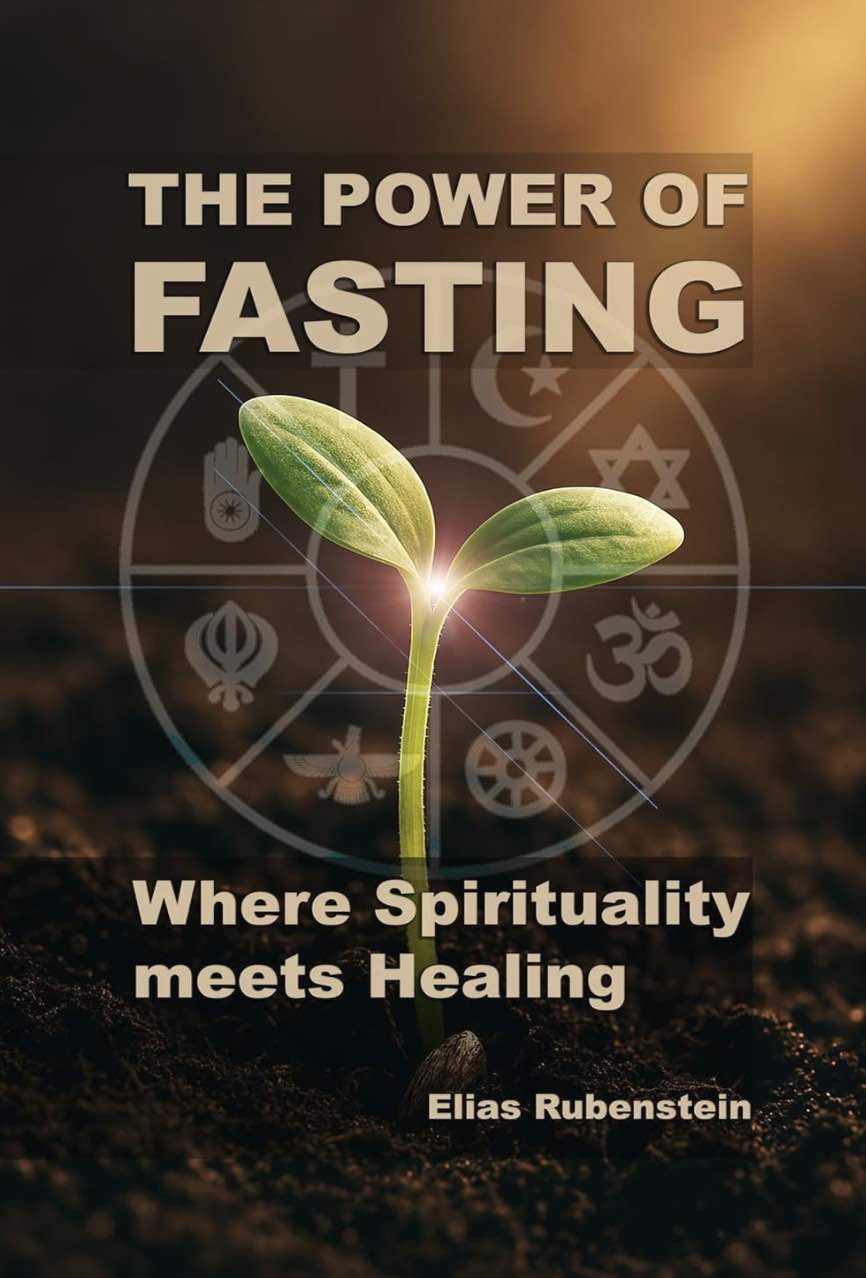
The Power of Fasting – Between Spirituality and Healing
By Dr. Elias Rubenstein
EXCERPT
It begins with a simple decision — not to eat. And yet this decision can change everything. For fasting is far more than physical abstinence. It is a mental and spiritual pause, an inner stillness, a conscious stepping out of the endless cycle of consumption, habit, and distraction. For thousands of years, fasting has been among humanity’s oldest and most sacred practices. Prophets, sages, mystics, and healers from all cultures understood: whoever fasts enters a realm beyond the visible. A realm where body, mind, and soul begin to communicate with one another. A realm where healing becomes possible — not only on a physical level, but within the deepest layers of our being.
Fasting has its roots in the mystery traditions of Egypt, in the monasteries of India, in the deserts of the early Christians, and in the teachings of Buddhists, Jains, and Daoists. It was never merely a diet, never merely a method. It was purification. Insight. Preparation for the sacred. Ancient cultures understood that fasting does not only cleanse the blood — it also purifies the heart. Whoever becomes empty becomes open. And whoever opens themselves encounters what is truly real.
Today, in an age of excess, this ancient practice is more relevant than ever. We live in a world of too much — too much food, too much stimulation, too much speed. Yet despite having everything, something is missing. We eat, but we are not nourished. We know, but we are not wise. We function, but we no longer truly feel ourselves. Fasting is the counter-movement. The quiet answer to the noise of the world.
This book invites you to rediscover fasting — beyond diets, calorie charts, and rigid rules. It is a guide back to a simple yet profound practice that heals not only the body, but also touches the soul. Discover why fasting works — on a spiritual, physical, and emotional level. Be inspired by ancient traditions in which fasting was regarded as a gateway to higher consciousness and inner wisdom. And discover how modern science increasingly confirms what the sages of earlier cultures already knew: human beings possess the ability to renew themselves — if they are willing to become still, to let go, and to listen inwardly.
This book is not a call to asceticism. It is a call to reconnection. It shows that within every apparent sacrifice lies a gift — a space of insight, clarity, and strength. Whoever fasts encounters themselves. Not in fullness, but in emptiness. And it is precisely there that the essential begins.
For fasting is not merely the abstinence from food. It is the conscious withdrawal from an inner excess. The decision to no longer be driven by cravings, thoughts, and habits that overshadow one’s true nature. It is a return. A remembrance. A path inward.
The body uses fasting for purification. The mind uses it for clarity. And the soul — it uses it to reconnect with what is original, pure, and uncorrupted. In emptiness, a listening begins. And within this listening, more truth is often revealed than within any amount of information. Whoever fasts begins to realize that what is essential is not loud. It is silent. It is deep. And it has always been there.
Table of Contents
Introduction
Chapter 1: Fasting as a Spiritual Key to Transformation
1.1. Fasting in Spiritual Traditions
1.2. Access to Deeper Knowledge and Experience
1.3. Preparation for Initiation, Prayer, and Meditation
1.4. The Myth of Inner Purification
Chapter 2: Religious Fasting Traditions
2.1. Fasting in Christianity
2.2. Fasting in Judaism
2.3. Fasting in Islam
2.4. Fasting in Buddhism
2.5. Fasting in Hinduism
2.6. Fasting in Other Religions
Chapter 3: Fasting in the Mystery Traditions
3.1. Fasting in the Egyptian Mysteries
3.2. Fasting in the Eleusinian Mysteries of Greece
3.3. Fasting among the Pythagoreans and Orphics
3.4. Fasting in Roman Cults
3.5. Fasting in Modern Mystery Cults
Chapter 4: Extreme Asceticism
4.1. The Radical Path to Spiritual Purity in Jainism
4.2. Food Abstinence among Hindu Sadhus
4.3. Purification and Healing in Shamanism
4.4. Self-Mummification in Buddhism
4.5. Self-Denial in Christianity
4.6. Asceticism in Judaism
Chapter 5: Healing Through Fasting
5.1. Fasting as a Bridge Between Mind and Body
5.2. Cellular Self-Cleansing Processes
5.3. Strengthening the Immune System
5.4. Insulin Resistance and Metabolic Renewal
5.5. Improving Gut Health
5.6. Stem Cell Regeneration
5.7. Fasting and Its Effects on Cancer Cells
5.8. Enhancing Brain Health
Chapter 6: Dry Fasting
6.1. The Effects of Dry Fasting
6.2. The Body’s Ability to Produce Water
6.3. Maximum Duration and Risks of Dry Fasting
6.4. Religious versus Therapeutic Dry Fasting
Chapter 7: Water Fasting
7.1. How Water Fasting Works
7.2. The Effects of Water Fasting
7.3. Maximum Duration of Water Fasting
7.4. Breaking the Fast
Chapter 8: Alternative Forms of Fasting
8.1. Liquid Reduction Fasting
8.2. Fruit Fasting
8.3. Ketogenic Nutrition
8.4. Calorie Restriction
Chapter 9: Spiritual Fasting
9.1. Mental Fasting
9.2. Emotional Fasting
9.3. Instinctual Fasting
9.4. Material Fasting
Afterword